From December through February, Japan in winter does not offer one uniform season. In Tokyo, visitors usually find bright, cool days and little snow; in Hokkaido, temperatures stay below freezing from December to March; and in mountain regions, snowfall becomes ski terrain, ice-covered trees, and outdoor hot-spring scenery. Instead of asking only whether winter is cold, decide which version of Japanese winter you want to experience.
Japan in winter: when the season starts and how cold it gets
By the meteorological definition, winter in Japan covers December, January, and February. Of the three months, December is the mildest, although it becomes noticeably colder from midmonth. Nationally, January and February are the coldest months.
Across the country, the average winter temperature is 5.1°C (41.2°F). Behind that national figure lie major regional differences. The Siberian High and the Aleutian Low drive cold northwesterly winds, and these winds separate a mild Pacific-side city day from a much harsher northern or mountain trip.
For planning purposes, December is the transition month: it is winter, but the deepest cold generally comes later. January and February are the months to choose for the strongest chance of established snow in snow regions and the coldest conditions nationwide.
Winter in Tokyo answers the big snow question
Winter in Tokyo is usually clearer and sunnier than many visitors expect. During the day, temperatures average 4°C to 12°C (40°F to 53°F), so a city itinerary can feel crisp rather than relentlessly severe.
Does it snow in Tokyo? Yes, but not often or deeply by Japanese snow-country standards. The city averages only 5 to 10 centimeters of snow a year, usually spread across two or three days with measurable snowfall of at least 1 centimeter. The Pacific side, including Tokyo and Osaka, is generally drier and milder than the snowier Japan Sea side.
Rare exceptions still matter. On February 8, 2014, Tokyo recorded 27 centimeters of snow, and the resulting conditions disrupted city traffic. For that reason, a Tokyo winter packing list should not be built around constant snow, while a northern itinerary should be.
Follow the snow from Hokkaido to the Japan Sea coast
Geography supplies the broadest rule: the northwestern side of Honshu along the Japan Sea receives the most snow, while the Pacific side is drier and milder. Hokkaido is the clearest example of sustained cold: it remains below freezing from December through March and averages 130 days with snowfall in a winter season.
In Sapporo, the scale becomes concrete. In December alone, the city averages 113 centimeters of fresh snow. Average temperatures run from a high of 2°C (36°F) to a low of −4°C (25°F). Unlike Tokyo’s occasional flurry, these conditions make snow part of the setting for months.
| Place | Winter pattern | Useful scale |
|---|---|---|
| Tokyo | Drier, milder Pacific-side winter | 4–12°C daytime average; 5–10 cm snow per year |
| Hokkaido | Below freezing from December to March | About 130 snowfall days per season |
| Sapporo in December | Urban snow and sustained cold | 113 cm fresh snow; 2°C high, −4°C low |
| Hakuba Valley | Japanese Alps snow country | About 11 meters of annual snowfall |
| Zao Onsen | Mountain snow and Juhyo conditions | 2–3 meters of snow per winter |
The table is a reason to choose one region deliberately rather than treating “Japan in winter” as a single forecast. Tokyo can be a clear city base at the same time that Hokkaido and the Japanese Alps demand winter-specific clothing and footing.
Choose ski country by the winter you want
For a snow trip, Niseko and Hakuba offer two different models. On Hokkaido, Niseko receives an average of 15 meters of fresh snow annually, placing it among the snowiest places on Earth. Its snow season runs from late November to early May.
Within Niseko United, four resorts are linked: Grand Hirafu, Hanazono, Annupuri, and Niseko Village. Together, they have 29 lifts and 47 kilometers of groomed runs. Those numbers show a connected four-resort network rather than one isolated slope.
In Nagano, Hakuba Valley brings together 11 resorts, 146 lifts, and more than 200 runs. The valley receives around 11 meters of snow a year. Its season runs from late November or early December until early May at higher elevations.
In Yamagata, Zao Onsen offers a third winter image. There, 2 to 3 meters of snow create the conditions for Juhyo, the ice-and-snow formations often called snow monsters. From late December to mid-March, icy Siberian winds coat fir trees with frozen condensation. The Zao Ropeway passes directly over the Juhyo forest, and the formations are illuminated at night.
See how snow became a Sapporo festival and winter lights
The Sapporo Snow Festival began small. On February 6, 1950, six high school students made six snow statues in Odori Park. About 50,000 people attended that first event. In 1955, the Japan Self-Defense Forces built the first monumental sculptures; in 1972, the year Sapporo hosted the Winter Olympics, the festival became internationally known.
Its scale is easiest to measure in snow and trucks: about 32,000 tons of snow arrive from Sapporo’s outskirts in approximately 6,000 truckloads to build roughly 160 to 200 sculptures. In 2024, 2.39 million visitors attended the festival. Since 1983, Susukino’s ice carvings have been an official part of the overall festival, adding a second material and a different kind of detail to the winter display.
Beyond snow destinations, winter illuminations extend the evening season. Across Japan, they generally run from mid-November to mid-February, and some parks keep displays open until May. Sapporo White Illumination uses about 730,000 LED lights. In Mie, Nabana no Sato has a 200-meter light tunnel and more than 8 million LEDs.
The two experiences work on different scales: the Snow Festival turns hauled snow into temporary sculpture, while an illumination turns a park or city space into a field of light. Together, they show why winter is not simply the quiet season between fall foliage and spring blossoms.
Warm up in an onsen, then meet the snow monkeys
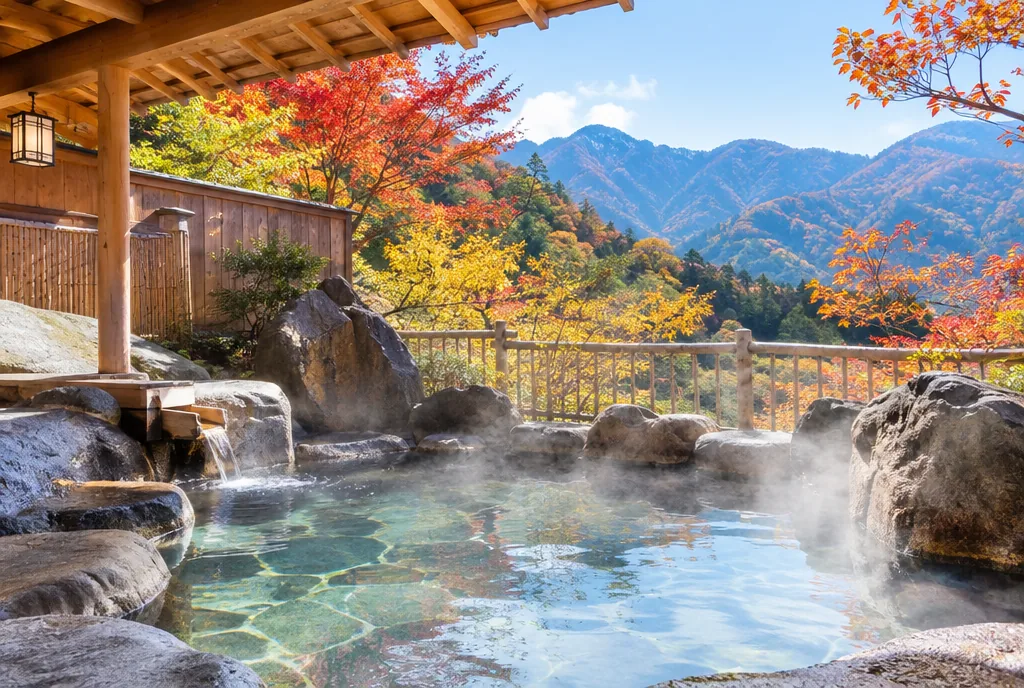
One of winter’s sharpest contrasts is a rotenburo, or outdoor hot spring: hot water against a snow-covered landscape. Before entering a shared onsen, etiquette starts with washing and rinsing completely. In the communal water, swimwear is not allowed, except in private baths.
At some public onsen, guests with tattoos may be turned away, although many now offer tattoo-friendly times or cover patches. Before treating a shared bath as an automatic stop, check that detail. In snow regions, Ginzan Onsen, Zao Onsen, and Kinosaki Onsen are especially atmospheric in winter, when the baths remain open and there may be fewer guests.
For a specific winter wildlife sight, go to Jigokudani Yaen-Koen in Nagano, the only place in the world where wild macaques bathe in natural hot springs. To escape the cold, snow monkeys use the hot springs in winter, not in summer. For the classic snow-covered scene, January and February are best, when snow is deepest and bathing is most reliable.
Even so, keep your expectations realistic. From the Kanbayashi Onsen parking area, visitors walk 1.6 kilometers through winter terrain to the park, a journey of about 20 to 30 minutes. For the route, good footwear and spikes are essential. Despite controlled feeding that draws them toward the park, the monkeys are not guaranteed to appear and their behavior cannot be controlled.
Pack for the region instead of packing one huge coat
In Tokyo, Kyoto, and Osaka, use layers: thermal underwear, a sweater, and a water-resistant jacket. Because indoor spaces are strongly heated, the ability to remove layers matters as much as warmth outside. A bulky outfit that feels sensible on a Tokyo street can become uncomfortable on a heated train or in a department store.
For Hokkaido and mountain areas, start with a different baseline: snow boots, waterproof gloves, and a thick down jacket. There, temperatures often fall below −10°C (14°F). On northern and mountain sidewalks, ice can make traction more important than a stylish shoe that cannot grip a frozen surface.
- Use removable layers for Tokyo, Kyoto, and Osaka because indoor heating is strong.
- Use snow boots and waterproof gloves for Hokkaido and mountain routes where temperatures often drop below −10°C.
- Choose footwear that is easy to take off and put back on: traditional restaurants and temples require shoes to be removed.
- Prioritize slip-resistant soles on icy northern and mountain sidewalks.
In practice, the distinction is simple. For the coldest part of the day and the region you will actually visit, dress warmly, but make every layer easy to adjust once you enter heated interiors or remove shoes.
Leave these Japan winter myths behind
Myth: Tokyo is a snow city
Tokyo does get snow, but usually only 5 to 10 centimeters over a year and normally on two or three days with at least 1 centimeter. More typically, clear, sunny weather and daytime temperatures of 4°C to 12°C define winter there, not the continuous snow of Hokkaido.
Myth: every part of Japan has the same winter
The most snow falls along the Japan Sea side, while Tokyo and Osaka on the Pacific side are drier and milder. Hokkaido remains below freezing from December through March, whereas Tokyo’s winter daytime average reaches 12°C at the upper end.
Myth: snow monkeys are guaranteed
Jigokudani’s macaques are wild. January and February offer the most reliable winter conditions, but the animals’ appearance cannot be guaranteed even though the park uses controlled feeding to attract them.
Myth: onsen means swimwear is fine
In a shared onsen, visitors wash and rinse before entering and do not wear swimwear. Private baths are the stated exception.
Frequently Asked Questions
What months are winter in Japan?
Meteorological winter in Japan is December, January, and February. December is the mildest winter month, but it becomes noticeably colder from midmonth.
When does winter start in Japan?
Winter starts in December by the meteorological definition. Cold northwesterly winds associated with the Siberian High and Aleutian Low shape the season, and January and February are the coldest months.
How cold does Japan get in winter?
Japan’s nationwide winter average is 5.1°C (41.2°F), but regions vary sharply. Tokyo daytime temperatures average 4°C to 12°C, while Hokkaido and mountain areas often fall below −10°C.
Is Japan worth visiting in the winter?
It is worth it if you choose a winter experience deliberately: clear Tokyo days, Hokkaido snow, Niseko or Hakuba skiing, outdoor onsen, Sapporo snow sculptures, illuminations, or Jigokudani’s snow monkeys all show different sides of the season.
Where does it snow in Japan?
The Japan Sea coast and northern and mountain regions receive the deepest snow. Hokkaido stays below freezing from December through March, while Hakuba Valley averages about 11 meters of annual snowfall and Zao Onsen gets 2 to 3 meters each winter.
What is Japan in December like?
December is the mildest winter month, although temperatures become noticeably colder from midmonth. In Sapporo, December averages 113 centimeters of fresh snow; in Tokyo, the season is generally clear and sunny with average daytime temperatures from 4°C to 12°C.