Japanese New Year, known as Shogatsu or Oshogatsu, is Japan’s most important holiday period: a tightly patterned season of year-end noodles, temple bells, first prayers, symbolic food, cards, and family visits. The public holiday is January 1, but the rhythm begins on New Year’s Eve and extends through the first three days of January. Its customs are easy to recognize in a single morning: a bowl of mochi soup, a crowded shrine approach, a small envelope of money for a child, and a formal greeting for the year that has just begun.
Japanese New Year follows January 1—not the Lunar New Year
In Japanese, the New Year is Shogatsu (正月), or the more polite Oshogatsu. January 1 itself is Ganjitsu (元日), and the first three days of January are Sanganichi (三が日). More than a midnight celebration, the holiday gives families time to visit, pray, eat seasonal dishes, and make their first outings of the year.
Japanese New Year and Chinese New Year are not the same event. Japan has observed New Year on January 1 under the Gregorian calendar since 1873. Chinese New Year follows a lunar calendar and falls in January or February. That difference explains why a visitor can see Japanese New Year decorations and packed shrines around January 1 without seeing a nationwide Lunar New Year holiday.
The calendar changed abruptly. Five years after the Meiji Restoration, Japan adopted the Gregorian calendar by law: December 3, 1872, under the old lunar calendar, was followed directly by January 1, 1873. Nearly 27 days disappeared from the calendar, an episode often called Japan’s “lost month.” The change was part of a wider effort to modernize and to present Japan as a nation on equal footing with Western powers.
Yet the national picture is not the whole story. In Okinawa and the Amami Islands of Kagoshima, communities still celebrate Lunar New Year alongside the January 1 observance. Okinawa also keeps many traditional festivals, including Obon, on the lunar calendar. In these regions, the Gregorian calendar did not replace every custom; the two calendars exist side by side.
Greetings mark the boundary between the old and new year. Before January 1, people say Yoi otoshi o, meaning “Have a good year.” From January 1, the standard greeting is Akemashite omedetou gozaimasu, “Congratulations on the opening of the year.” Young people may shorten it to Akeome, sometimes followed by Kotoyoro, a casual wish for continued goodwill. On a formal New Year card, Kinga shinnen is a conventional written greeting.
From New Year’s Eve to January 7, each day has a role
Shogatsu starts with a deliberate crossing from one year to the next. On Omisoka, December 31, many people eat Toshikoshi Soba, or sometimes Toshikoshi Udon. The long buckwheat noodles stand for a long life and for crossing from the old year into the new one. One bowl turns an ordinary supper into a marker of transition.
At midnight, Buddhist temples perform Joya no Kane. Their bells ring 108 times to drive away the 108 worldly desires of humankind. The timing matters: the first 107 strikes sound on December 31, and the final strike comes after midnight. The bell is therefore not simply a countdown; it belongs to a ritual of leaving accumulated desires behind.
On New Year’s morning comes Ozoni, a soup with mochi whose ingredients and style change dramatically by region. After the meal come shrine or temple visits, calls on relatives, cards in the mail, and gifts for children. The early days are family-centered, yet their public scale is striking: shrines draw enormous crowds, and much of the country pauses at once.
On January 7, many households eat Nanakusa-gayu, rice porridge with seven spring herbs. After the dense holiday dishes, this porridge is intended to be gentle on an overworked stomach. Its place on January 7 also shows the long arc of Shogatsu: a season that begins with noodles and bells does not end the next morning.
New Year also has an unexpected musical association. Across Japan, Beethoven’s Ninth Symphony is traditionally performed during the season. In December 2009 alone, there were 55 performances nationwide. The custom traces back to German prisoners of war during World War I and shows how a modern Japanese holiday can carry traditions from very different histories.
Hatsumode turns a first visit into a shared national ritual
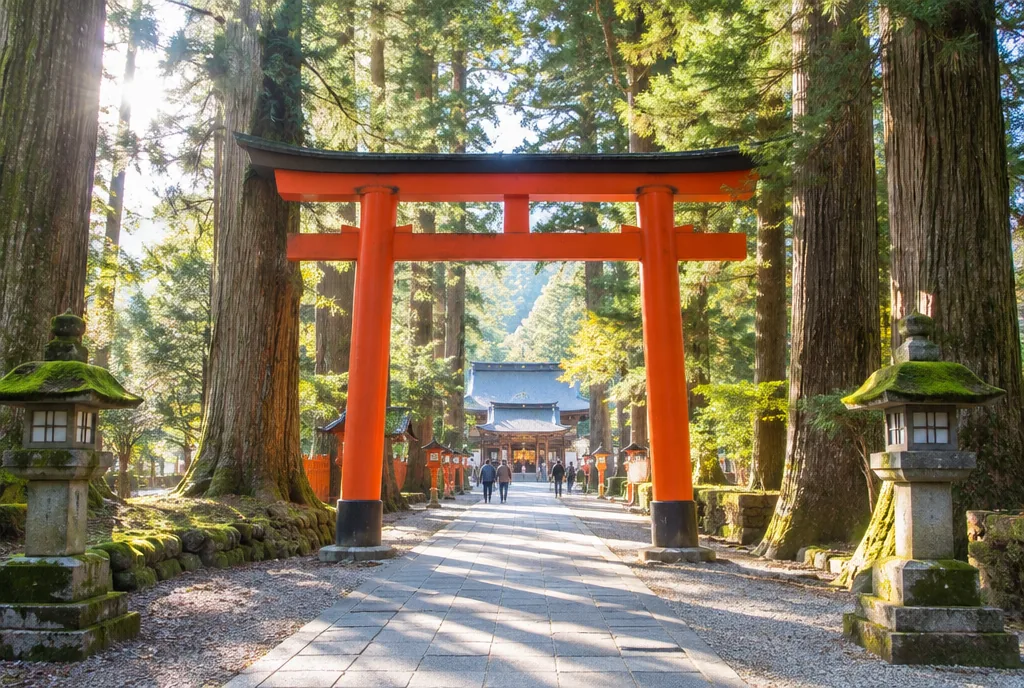
Hatsumode is the first visit of the new year to a shrine or temple. It usually happens during Sanganichi, when people queue to pray, buy protective charms, and begin the year in a place of worship. Each year, an estimated 90 million people, more than 70 percent of Japan’s population, take part. That makes it the country’s largest shared cultural event by participation.
At major sites, the crowds are especially visible. During the first three days, Meiji Jingu in Tokyo receives more than 3 million visitors. About 2.8 million visit Senso-ji in Asakusa, 2.7 million Fushimi Inari Taisha in Kyoto, and 2 million Sumiyoshi Taisha in Osaka. Such numbers explain why hatsumode is not a quiet sightseeing stop during this period; it is a mass annual movement.
| Hatsumode destination | Visitors during the first three days |
|---|---|
| Meiji Jingu, Tokyo | More than 3 million |
| Senso-ji, Asakusa | About 2.8 million |
| Fushimi Inari Taisha, Kyoto | About 2.7 million |
| Sumiyoshi Taisha, Osaka | About 2 million |
At a Shinto shrine, the standard sequence is clear and memorable: place a coin, called osaisen, into the offering box; bow twice; clap twice; and bow once more. The formula is often expressed as ni-rei, ni-hakushu, ichi-rei: two bows, two claps, one bow. For a visitor, it is both a practical guide and a concise expression of a formal ritual.
Many people buy omamori, protective amulets, for the coming year. Amulets from the previous year are commonly burned at the shrine. At the busiest locations, the crowd itself becomes part of the experience. At Sumiyoshi Taisha, visitors sometimes throw coins over the heads of people in front of them; coins can be seen lodged between the roof shingles. The detail is vivid because it comes from pressure, not performance: so many people are trying to reach the offering space at once.
Japanese New Year food puts wishes into every box and bowl
Osechi-ryori, the signature Japanese New Year food, is a collection of prepared dishes arranged in tiered lacquer boxes called jubako. The stacked boxes symbolize accumulated good fortune. Each item carries a wish, so the meal is more than a menu. One box can hold hopes for health, children, knowledge, harvests, prosperity, and celebration, expressed in carefully chosen colors and forms.
Osechi goes back to the Nara period, when it began as rice offered to the gods during the five seasonal festivals known as Gosekku. During the Genroku era in the late 17th century, rising prosperity among merchants helped spread the food through the wider population. Serving it in jubako boxes began in the Meiji period.
| Osechi dish | What it signifies |
|---|---|
| Kuromame, black soybeans | Health; mame sounds like “health.” |
| Kazunoko, herring roe | Many children: kazu means number and ko means child. |
| Tazukuri, dried sardines in soy sauce | A rich harvest; its name literally means “rice field maker.” |
| Datemaki, a sweet egg roll | Growth in knowledge because it resembles a scroll. |
| Kurikinton, chestnut and sweet-potato mash | Financial prosperity through its golden color. |
| Red-and-white kamaboko, fish cake | Festivity; the colors recall the Japanese flag. |
In osechi, symbolism becomes concrete. The name kazunoko breaks into “number” and “child.” The literal name of tazukuri carries an agricultural wish. The gold color of kurikinton turns a simple mash into a wish for financial prosperity. Together, these associations explain why the food remains recognizable as New Year food even as individual households choose different dishes.
Ozoni works differently. It is a hot mochi soup eaten on the morning of January 1, and its regional variations are among the clearest signs that Shogatsu is not one uniform menu. The broth, the shape of the mochi, and the toppings in a single bowl can tell a regional story.
Mochi and ozoni reveal a regional map in one New Year meal
Mochi is central to Shogatsu, both as food and as decoration. During Mochitsuki, steamed glutinous rice is pounded in a wooden mortar called an usu with a large wooden mallet until it becomes soft mochi. This traditional New Year practice turns a basic ingredient into a shared activity.
Kagami Mochi is a New Year decoration made of two round layers of mochi with a bitter orange, daidai, on top. The orange symbolizes “from generation to generation,” so the decoration makes continuity visible at the beginning of the year.
Across Japan, ozoni divides into two broad culinary worlds. In the Kanto region around Tokyo, a clear soy-based soup holds grilled square mochi. In the Kansai region around Kyoto, white miso holds round, boiled mochi. The rough boundary between these styles runs near Sekigahara in Gifu Prefecture, close to the site of the decisive 1600 battle of the samurai era.
Beyond those two styles, regional versions go much further. In Kagawa, Anmochi-zoni contains mochi filled with sweet bean paste. In Iwate, walnut paste goes into the soup. In Miyagi, grilled goby tops the soup. These are more than small garnish changes; they show how one New Year dish can take on very different local identities while keeping mochi at its center.
Cards, cash gifts, and decorations make renewal visible
Nengajo are New Year postcards mailed in December and guaranteed by Japan Post to arrive on January 1. That synchronized arrival makes the first morning of the year a national mail moment. Special cards issued by Japan Post show the zodiac sign of the coming year and carry a lottery number; prizes range from stamps to household appliances. The service accepts cards from early November until about December 25; cards posted after the cutoff arrive late.
The custom is still familiar, but it is shrinking quickly. In 2003, Japan Post delivered about 4.4 billion nengajo; by 2025, circulation had fallen to 1.07 billion. On January 1, 2025, only 363 million cards were delivered, down 34 percent from the previous year and the 17th consecutive decline. One factor was the domestic postage increase from 63 yen to 85 yen in October 2024, about 35 percent.
A growing trend called Nengajo-jimai means deciding to stop sending the cards for good. In one survey, 80 percent of people who had stopped said they had done so within the previous five years. The main reason: social media such as LINE and email are enough. Despite the decline, the cards still carry meaning, and the coordinated January 1 delivery stands out all the more.
For Otoshidama, adults give cash to children at New Year. The money goes into small decorated envelopes called pochi-bukuro; handing it over loose is inappropriate. New bills, shinsatsu, are expected, because old, crumpled notes do not suit a new beginning. The custom began with offerings to the New Year deity Toshigami, first as mochi and later as money.
There is no fixed amount, but a common rule of thumb is about 3,000 yen for elementary-school children and 5,000 yen for middle- and high-school students. In one survey, 44.4 percent of parents considered 5,000 yen the right amount for a middle-school student. Most parents stop giving otoshidama when a child finishes high school, around age 18; 49.6 percent of respondents said so. The practice is cheerful for children but expensive for adults: 77.2 percent described it as some or a large financial burden, with gifts for nieces and nephews accounting for the main share for 76.9 percent.
Decorations frame these personal exchanges. Kadomatsu, arrangements of bamboo, pine, and plum blossoms, stand at entrances to welcome Toshigami. Shimekazari is a braided straw-rope decoration with fern leaves and a bitter orange, hung above a door to keep evil spirits away. Children’s activities include hanetsuki, a shuttlecock game like badminton; takoage, kite flying; karuta, cards with poems; and fukuwarai, placing facial features on a blank face while blindfolded.
Traveling during Shogatsu requires more planning than usual
January 1 is Japan’s only official legal New Year holiday, but the practical shutdown is much longer. Almost all stores, offices, and government agencies close roughly from December 29 through January 3. That gap between the formal holiday and the lived holiday is one of the most important things for a traveler to understand.
Banks, post offices, and government offices are closed. ATMs work, but they may be refilled only on a limited basis, so travelers should withdraw cash before December 29. Temples, shrines, and convenience stores remain open, which is why a city can feel quiet in one neighborhood and intensely busy around a major shrine.
Most department stores reopen on January 2. Their return is marked by fukubukuro, “lucky bags”: sealed bags of merchandise worth several times the purchase price. The appeal is deliberately uncertain; buyers know they are receiving value but do not know exactly what is inside.
Travel has its own rhythm. The return wave known as the U-turn peaks from January 2 through January 4, and Shinkansen seats should be reserved as soon as booking opens. On January 1, by contrast, trains are almost empty. A visitor who treats all three days as equally busy can miss this useful distinction.
Common misconceptions hide the most interesting parts of Shogatsu
Myth: Japanese New Year is simply Japan’s version of Chinese New Year. The two are separate celebrations on different calendars. Japanese Shogatsu is fixed to January 1 under the Gregorian calendar, while Chinese New Year follows the lunar calendar. Okinawa and the Amami Islands show the useful exception: local Lunar New Year observances still coexist with the January holiday.
Myth: January 1 is the only day that matters. Ganjitsu is the day itself, but Sanganichi covers the first three days, and preparations begin on Omisoka. The sequence includes Toshikoshi noodles, 108 temple bells, ozoni, hatsumode, cards, and otoshidama. January 7 adds nanakusa-gayu.
Myth: everybody eats the same ozoni. Tokyo-area Kanto commonly serves clear soy broth with square grilled mochi, while Kyoto-area Kansai uses white miso and round boiled mochi. Kagawa, Iwate, and Miyagi add their own distinctive versions. A dish that appears simple becomes a map of regional taste.
Myth: the season is only private family time. Family visits matter, but hatsumode is a huge public event. About 90 million people participate annually, and Meiji Jingu alone receives more than 3 million visitors in the first three days. Shogatsu joins intimate rituals with some of Japan’s largest crowds.
Frequently Asked Questions
What are Japanese New Years called?
The Japanese New Year is called Shogatsu or Oshogatsu. January 1 is Ganjitsu, and the first three days of January are Sanganichi.
Are Chinese and Japanese New Year the same?
No. Japan has celebrated New Year on January 1 under the Gregorian calendar since 1873, while Chinese New Year follows a lunar calendar and falls in January or February.
How is New Year celebrated in Japan?
Typical traditions include Toshikoshi Soba on New Year’s Eve, 108 Buddhist temple bells at midnight, ozoni on January 1, hatsumode visits, osechi food, nengajo cards, and otoshidama cash gifts for children.
Why do most Japanese people not celebrate Lunar New Year?
Japan adopted the Gregorian calendar in 1873 as part of modernization, fixing the official New Year to January 1. Okinawa and the Amami Islands still observe Lunar New Year customs alongside the January celebration.
What do people say for Happy New Year in Japanese?
From January 1, the standard greeting is Akemashite omedetou gozaimasu. Before the new year begins, people say Yoi otoshi o instead.