At its simplest, a tatami is a traditional Japanese floor mat: a woven igusa-rush surface over a thick core, made for sitting, sleeping, and shaping the proportions of a room. Yet its size can describe a home, its border carries old rules of respect, and its construction explains why a well-made mat costs far more than a thin decorative “Japanese mat.”
What a tatami is, from foldable mat to Japanese floor
In Japanese, the word tatami is written 畳. The name comes from tatamu, “to fold” or “to pile,” and refers to the earliest mats, which were thin enough to fold or stack when not in use. In major English dictionaries, tatami now appears as a loanword, but it should not be confused with goza, a different woven rush mat.
During the Heian period, from 794 to 1185, nobles used tatami as luxury cushions or bedding on wooden floors rather than as wall-to-wall flooring. At Tōdaiji temple in Nara, the oldest surviving tatami dates from the mid-eighth century.
Over time, tatami became a unit of interior design. A room can be described by its mat count, and the way the rectangles meet shapes its visual order. Outside the home, tatami are used in martial-arts training and competition, including judo, and have traditionally been used for tameshigiri, target test-cutting with swords.
How a tatami mat is built, layer by layer
A full tatami mat has three parts with distinct names. Knowing them makes it easier to understand both the feel of the floor and the care it needs.
| Part | What it is | Why it matters |
|---|---|---|
| Tatami-doko | The base or core | A traditional core is about 5 cm thick and made from compressed, sewn layers of rice straw. |
| Tatami-omote | The woven top surface | It is a weft-faced weave of soft rush grass, or igusa, on a hemp or cotton warp. |
| Tatami-heri | The cloth border along the long edges | It is usually brocade or plain cloth and once signaled the owner’s social status. |
Botanically, igusa is Juncus effusus. The cover of a high-quality tatami mat contains about 5,000 to 6,000 rush-grass strands; a higher count gives a denser surface and better texture. Over time, the familiar igusa aroma fades, although replacing the cover can restore it.
In modern construction, not every core is straw. As rice-straw supplies declined and concerns about mites and mold grew, compressed wood-chip board and extruded polystyrene foam became common substitutes. Along a tokonoma, the decorative alcove of a traditional room, some mats have no border at all.
Tatami mat sizes still measure a room
A common tatami is a 2:1 rectangle, approximately 0.91 by 1.82 meters, or 3 by 6 feet. That is a useful rule of thumb, not a universal manufacturing standard. Sizes differ enough between regions that a mat count tells you more about layout than about exact floor area.
| Regional size | Dimensions |
|---|---|
| Kyōma, associated with Kyoto | 191.0 × 95.5 cm |
| Inakama, associated with Nagoya | 182.0 × 91.0 cm |
| Edoma, associated with Tokyo and Kantō | 176.0 × 88.0 cm |
By traditional measurement, two tatami make one tsubo, a square of one by one ken measuring approximately 3.306 square meters. In Japanese property listings, including for apartments with Western-style floors, rooms are often advertised by the number of mats that would fit: a “6-jō room,” for example. In Japanese-style homes, common rooms range from 3- or 4.5-mat spaces to 6- and 8-mat rooms.
At about 5 cm, or 2 inches, traditional mats are substantial. For overseas shipping, a lighter version can be 15 mm thick and weigh 5 to 6 kg per mat. Both are sold as tatami, but they differ considerably in thickness.
A tatami room turns floor space into a washitsu
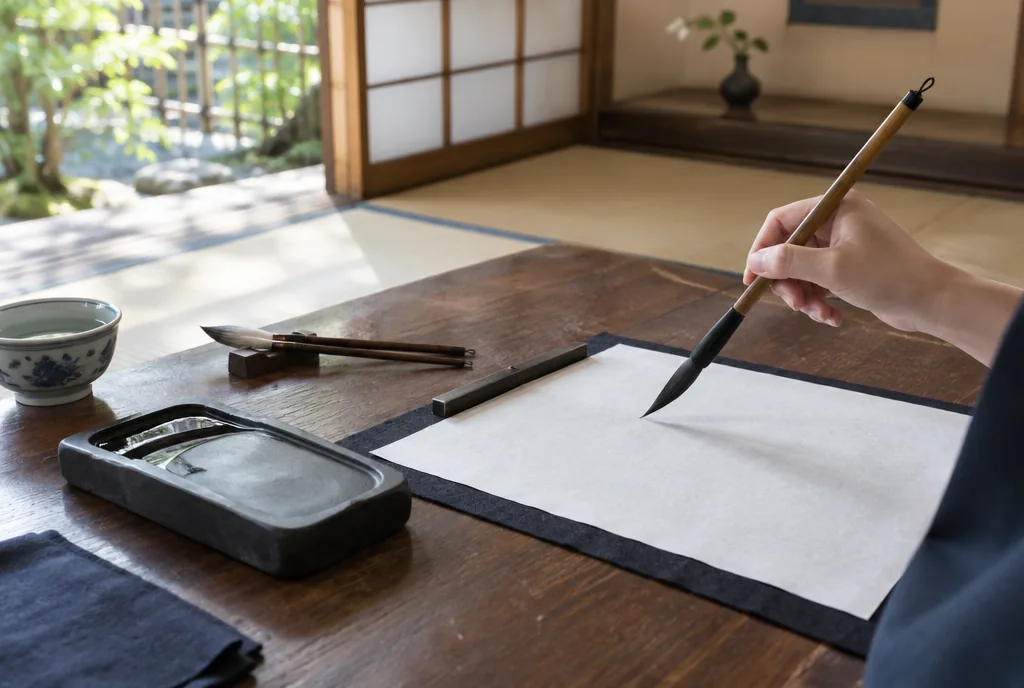
A tatami room is usually called a washitsu, meaning a Japanese-style room, or a nihonma. From the Muromachi period, a room fully covered with tatami was also called a zashiki. More than 90% of modern Japanese homes have at least one washitsu with tatami flooring.
Its floor is only one part of the setting. A washitsu commonly includes shōji, sliding paper screens; a tokonoma, an alcove for display; and a low chabudai table. In a tokonoma, a special mat may use mon-beri, a higher-quality patterned border.
That traditional room is not the default in every newer home. Since the 1990s, homes with wooden floors and no tatami have become more popular. Demand for tatami-omote covers in Japan fell from 45 million in 1993 to 14.9 million in 2012.
Sleeping on tatami: firm support, not a medical promise
Traditionally, a shikibuton futon is placed directly on tatami at night and stored in an oshiire closet during the day. That routine lets one room serve different purposes instead of leaving a bed in place all day. A large, continuous tatami surface can also hold several futons side by side.
A tatami sleeping surface is firm and breathable, typically 2.5 to 5 cm thick. George Cyril, MD, a physiatrist at Hospital for Special Surgery in New York, says this firmness can help maintain spinal alignment and avoid problems associated with overly soft, plush mattresses. It is not a guarantee that tatami will suit every sleeper or solve a health problem.
A Western-style tatami bed means something different from bedding directly on the floor. It is a low, usually solid-hardwood platform frame that holds tatami mats as a base, often with a futon mattress above. These frames are offered in Twin, Full, Queen, and King sizes; listed prices range from about $880 to $1,380.
Care keeps the woven surface from fading and warping
Tatami absorbs and releases moisture, helping regulate indoor humidity. That capacity also makes excess water a problem. For routine cleaning, vacuum once a week in the direction of the weave, not against it, so the rush strands are not damaged.
Direct sunlight makes igusa fade and become brittle. Shade a tatami room during peak sun hours. For a spill or stain, use only a slightly damp cloth; soaking the mat can cause mold and warping.
The omote surface typically lasts 5 to 6 years before replacement. Resurfacing keeps the existing core and replaces only that cover, at about ¥16,000 to ¥30,000 per mat in Japan. Traditional craftspeople also periodically sun-dry mats to reduce moisture and pests.
Tatami etiquette starts at the door and ends at the border
Remove shoes and slippers before stepping onto tatami. The rule protects the woven surface, but it is also a basic point of etiquette in a tatami room.
Then watch the heri, the cloth border. Stepping on it is considered rude. In the Heian and Muromachi periods, borders marked social rank, and treading on a superior person’s heri was a grave insult. In a tea room, the border can mark the boundary between the everyday world and the special ground of the ceremony.
The mats themselves have an etiquette of placement. Their joints should form T shapes, not a four-corner “+” intersection, which is considered inauspicious. Larger rooms often need half-mats to avoid that grid pattern.
Why quality tatami costs more than a simple floor mat
Price begins with the rush surface and the labor behind it. More strands mean a denser cover: depending on grade, an igusa surface uses roughly 4,500 to 6,000 strands per mat. Higher-grade mats require more hand-selection and hand-weaving, while the number of tatami craftspeople in Japan has been declining.
Supply is concentrated, too. More than 90% of igusa grown in Japan comes from Yatsushiro City in Kumamoto Prefecture on Kyushu. A Gokujō-grade mat, made using only the center of the best igusa, costs about ¥50,000 to ¥55,000 per mat in Japan. Carefully selected mid-range grades cost around ¥30,000 to ¥35,000, while the lowest domestic grade starts at ¥18,000.
That is why resurfacing, which replaces only the omote, is often the more economical choice: ¥16,000 to ¥30,000 per mat versus the cost of a new high-grade mat.
Common tatami misconceptions that flatten the story
“Tatami means any woven Japanese mat.” Not quite. Tatami is a Japanese word with a specific history and structure; goza is a different kind of woven rush mat.
“Every tatami has a rice-straw core.” Traditional mats do, but modern versions often use compressed wood-chip board or extruded polystyrene foam.
“A tatami room is just a room with a mat on the floor.” A washitsu is a Japanese-style room with tatami flooring and often related features such as shōji, a tokonoma, and a low chabudai.
“The border is only decoration.” The heri has carried social meaning, and avoiding it remains a visible sign of respect.
Frequently Asked Questions
What is a tatami?
A tatami is a traditional Japanese rectangular floor mat used for sitting, sleeping, and defining room size. It has a core, a woven igusa cover, and usually a cloth border.
Is tatami a Japanese word?
Yes. Tatami, written 畳, comes from tatamu, meaning “to fold” or “to pile,” referring to early mats that could be folded or stacked.
What are tatami mats made of?
Traditional tatami use a compressed rice-straw core about 5 cm thick, a woven igusa-rush cover on a hemp or cotton warp, and a cloth heri border. Modern cores may use wood-chip board or foam.
What is a tatami room?
A tatami room is a washitsu or Japanese-style room with tatami flooring. It often also has shōji screens, a tokonoma alcove, and a low chabudai table.
Is sleeping on tatami good for you?
Tatami offers a firm, breathable surface. An HSS physician says firm support can help maintain spinal alignment and avoid issues linked to overly soft mattresses, but the result depends on the individual and is not a medical guarantee.