Japanese convenience stores are called konbini, and they are far more than a place to grab a drink. A single stop can mean a crisp-wrapped onigiri, a hot bento, cash from an English-language ATM, a utility-bill payment, or a parcel drop-off. That combination of food, routine errands, and speed is what makes Japanese convenience stores such a useful part of daily life—and such a revealing first stop for visitors.
Why a konbini is more useful than its small footprint suggests
In Japanese, konbini is the shortened form of konbiniensu sutoa, itself derived from “convenience store.” Familiar though the name sounds to American visitors, the role is broader. With 56,054 convenience stores at the end of 2025, the format is a regular feature of neighborhoods, stations, and airports.
The modern story began with 7-Eleven. In 1974, its first Japanese store opened in Toyosu, Tokyo, after Kenji Yamamoto converted his family’s beverage shop. Instead of a rice ball or a cup of coffee, its first sale was sunglasses. A year later, the first experiment with round-the-clock opening began at a store in Koriyama, Fukushima.
Food is central to the experience, but it shares the floor with practical tasks. A store may offer an ATM, a counter for barcode bills, a terminal for tickets and prints, and a way to send a package. The result is not simply a smaller supermarket or a gas-station snack aisle. It is a compact stop built around needs that cannot wait for a larger store to open.
The Big 3 Japanese convenience stores make up most of the map
For travelers, the three names seen most often are 7-Eleven, FamilyMart, and Lawson. Together, they account for about 94 percent of Japan’s convenience-store locations. Behind each recognizable sign is a slightly different reason to browse.
| Chain | What to know |
|---|---|
| 7-Eleven | Japan’s largest chain, with 21,722 domestic stores; its 7 Premium line includes onigiri, sandwiches, and desserts. |
| FamilyMart | Known for FamiChiki, a breaded fried-chicken piece that costs 210 yen. |
| Lawson | Offers the Natural Lawson and Lawson Store 100 formats and is especially known for Uchi Café desserts. |
By scale, 7-Eleven is the clear answer to which chain is most popular. It is Japan’s largest, and its FY2025 sales made up 45.4 percent of the convenience-store market. FamilyMart is second with 16,449 stores, followed by Lawson with 14,616.
That does not make one chain the best for everyone. Any nearby branch covers the basics; the prepared food and specialties are what make comparing them worthwhile.
FamilyMart’s presence is especially dense in Tokyo, where it operates 2,443 stores. Lawson, meanwhile, traces its brand to a U.S. dairy shop; Daiei brought the name to Japan in 1975. Those origins are a useful reminder that Japanese konbini took an imported retail idea and developed it into a distinctly Japanese routine.
What to buy first: onigiri, bento, hot food, and an egg sandwich
On a first visit, begin with onigiri. At roughly 120 to 200 yen, these rice balls are the best-selling fresh-food category. At around 150 yen, tuna-mayo is the country’s best-selling flavor. Beyond it, common fillings include spicy cod roe, salmon, pickled plum, and kelp, while seasonal versions can feature ingredients such as cherry sea bream, chestnut, or matsutake mushroom.
The packaging is part of the lesson. On a typical onigiri wrapper, a numbered 1–2–3 sequence guides the opening. Pull the tabs in order and the film that keeps the seaweed away from the rice comes out last, so the nori is still crisp when you eat it.
For a full meal, look at the bento case. Konbini bento boxes generally cost 500 to 900 yen. A karaage bento with fried chicken is around 600 yen; a makunouchi bento with fish, chicken, egg, and pickled vegetables is around 700 yen; and a yakiniku bento with grilled beef is around 800 yen. At checkout, the cashier may ask, “Atatamemasu ka?”—“Would you like it warmed?”
Hot-counter food is another easy comparison point. FamilyMart’s FamiChiki costs 210 yen. Lawson’s four-piece Karaage-kun costs 240 yen and comes in flavors including spicy red and cheese yellow. In winter, all three big chains sell oden, a simmered assortment ordered piece by piece. Daikon, egg, fish cake, and konnyaku are common choices, generally priced from 80 to 150 yen per item.
The egg sandwich is simple, but not generic
The tamago sando, or egg-salad sandwich, is one of the foods most associated with a Japanese convenience-store visit. Lawson’s version is often judged the most balanced of the big three, with thicker, sweeter bread and a creamier filling. A mixed sandwich pack of tuna, egg, and ham-cheese costs 333 yen at Lawson, 321 yen at FamilyMart, and 302 yen at 7-Eleven.
Freshly ground coffee also belongs on the short list. Konbini coffee costs 110 to 220 yen: 7-Eleven’s SEVEN CAFE is 110 to 180 yen, FamilyMart’s FAMIMA CAFE is 130 to 200 yen, and Lawson’s MACHI café is 150 to 220 yen. A simple first visit can therefore be quite specific: choose a tuna-mayo onigiri, ask to heat a bento if wanted, and add coffee rather than treating the store as a last resort for packaged snacks.
Use a konbini for money, bills, tickets, and parcels
At the service counter, a konbini works differently from a typical U.S. convenience store. With a barcode, utility bills for electricity, gas, water, and telephone service can be paid in cash at any konbini. The cashier scans the code, takes payment, and gives a receipt that serves as proof of payment.
Japan also uses “konbini payment” for some online purchases. A customer selects the convenience-store option at checkout or at a terminal, receives a code, and pays cash at the register. It is a clear example of how cash and digital ordering can coexist rather than compete.
Every big-three chain has multifunction terminals. At 7-Eleven they are called Multi-Copy Machines; FamilyMart uses FamiPort; Lawson uses Loppi. They handle copies, event tickets, and prints. Names vary, but the visitor’s practical takeaway is simple: a stop for lunch can also solve a printing or ticketing task.
Parcel services follow the same pattern. Yamato Transport’s TA-Q-BIN can be sent from major konbini, with 7-Eleven and FamilyMart working with Yamato. Lawson works with Japan Post’s Yu-Pack. Yamato says its konbini drop-off service costs 100 yen less than a home pickup, a useful detail when comparing delivery options.
ATMs and IC card payment make a quick stop easier
For many overseas visitors, the most immediately useful service is the ATM. Seven Bank operates around 27,000 machines in 7-Eleven stores, stations, and airports. They are available 24/7 and offer 12 language options. Visa, Mastercard, Maestro, Cirrus, JCB, American Express, Diners Club, Discover, and UnionPay are accepted.
Before confirming a withdrawal, check the limits and fees. At a Seven Bank ATM, a foreign card can withdraw up to 100,000 yen per transaction; a magnetic-stripe-only card is limited to 30,000 yen. For withdrawals up to 10,000 yen, the charge is 110 yen; for larger withdrawals, it is 220 yen, on top of any fee from your home bank. At Lawson, Lawson Bank provides the ATMs, while FamilyMart uses the E-net network.
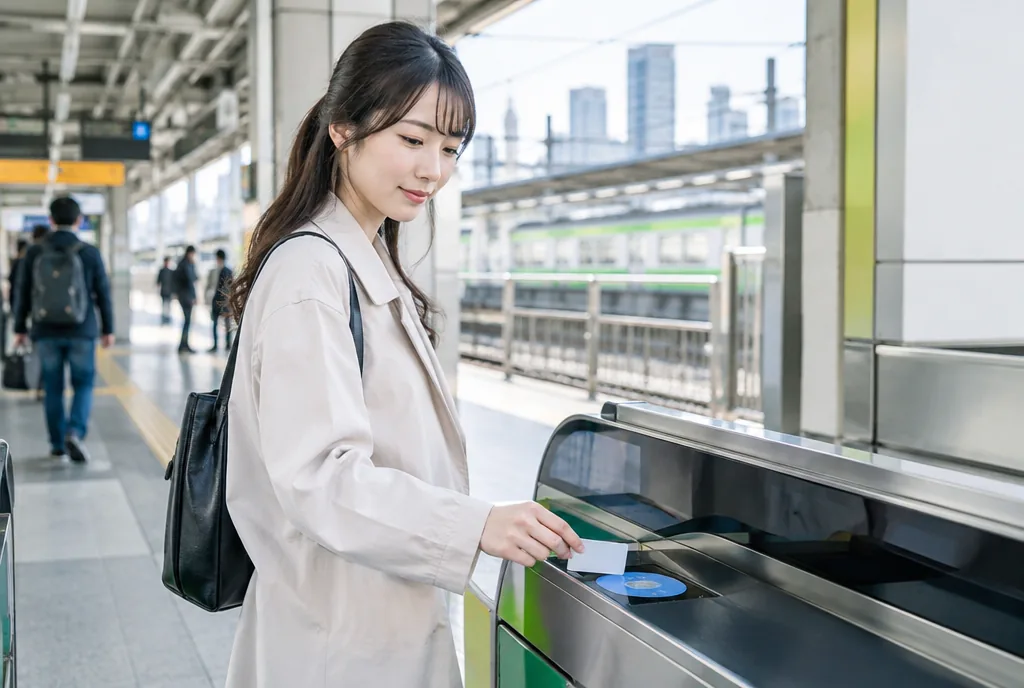
For everyday purchases, contactless IC cards are faster. Konbini accept cards including Suica, Pasmo, ICOCA, Kitaca, TOICA, and MANACA: tap the reader at checkout and the prepaid yen balance covers the purchase. Because the value is already in yen, this method does not add a foreign-currency fee. IC cards can also pay for TA-Q-BIN shipping.
Cash still has a major role in Japan. The national cashless-payment share reached 42 percent in 2024, leaving 58 percent of payments in cash. That context helps explain why an ATM, a cash bill-payment counter, and a ready meal can all be essential services under one roof.
Save on fresh food late at night and handle trash carefully
After about 9 p.m., look for yellow discount stickers on bento, onigiri, and other fresh items. These “nesage” price cuts are usually 30 to 50 percent and start once an item has passed two-thirds of its sell-by window. The food is still legally within its shelf life the next day, so this is a sensible way to put together a low-cost dinner.
One etiquette point matters more than many visitors expect: konbini trash bins are primarily for customers who bought something at that store. Japan has few public street bins, and 21.9 percent of 4,000 tourists surveyed by the Japan Tourism Agency identified that shortage as their biggest problem. Do not treat the store as a place to dispose of accumulated rubbish from elsewhere.
When you do use a bin for your own konbini packaging, sort it. Stores separate burnable trash, cans, PET bottles, and sometimes glass bottles. The rule is small, but it respects the system that makes a quick meal or drink easier to manage on the move.
Three common myths can lead to a disappointing first visit
Myth: A konbini is only for snacks
Snacks and drinks are there, but they are only one part of the offer. Onigiri, bento, hot chicken, oden, sandwiches, coffee, ATMs, bills, parcels, and multifunction terminals explain why the store serves both a hungry traveler and a resident running an errand.
Myth: Any bin is a public trash can
Konbini bins are intended for the packaging of customers’ purchases. Sorting that packaging is expected. The limited number of public bins is precisely why bringing outside trash into a store is poor etiquette.
Myth: 7-Eleven in Japan is the same as 7-Eleven in the United States
It is not. Seven & i Holdings in Tokyo operates Japan’s 7-Eleven, and its product assortment and quality differ substantially from the U.S. chain. Familiar signage may get you through the door; the food case and range of services are what show the difference.
Japanese konbini ideas are already reaching the United States
There are Japanese convenience-store connections in the United States, although they do not reproduce the Japanese experience exactly. FamilyMart has a U.S. operation under the name Famima. Its first U.S. store opened in West Hollywood, California, in 2005, and the brand has several locations in New York and other U.S. cities.
Japanese-style food has crossed over as well. 7-Eleven Inc. introduced a Japanese egg-salad sandwich to 7-Eleven, Speedway, and Stripes stores nationwide in December 2025. The U.S. version uses milk bread and Japanese Kewpie mayonnaise, but it is not identical to the Japanese sandwich: it has a crust and a lower filling-to-bread ratio.
That distinction is useful for travelers and food fans alike. A U.S. launch can offer a taste of a konbini favorite, while a stop in Japan brings the food together with the broader network of ATMs, bill payment, shipping, and late-night fresh-food discounts.
Frequently Asked Questions
What are Japanese convenience stores called?
They are commonly called konbini, a shortened form of konbiniensu sutoa, derived from “convenience store.”
What is the most popular convenience store in Japan?
By domestic store count, 7-Eleven Japan is the largest chain, with 21,722 stores. FamilyMart and Lawson are the other two members of the Big 3.
What is special about Japanese convenience stores?
They combine ready-to-eat food with services such as ATMs, cash bill payment, parcel shipping, printing, and ticketing. That mix makes a konbini useful for daily errands as well as meals.
What are the big 3 convenience stores in Japan?
They are 7-Eleven, FamilyMart, and Lawson. Together, they account for around 94 percent of convenience-store locations in Japan.
What do Japanese convenience stores sell?
Typical choices include onigiri, bento, egg sandwiches, hot chicken, oden in winter, desserts, drinks, and freshly ground coffee. They also provide practical services rather than only merchandise.
Are there Japanese convenience stores in the US?
Yes. FamilyMart operates U.S. stores as Famima, and U.S. 7-Eleven, Speedway, and Stripes locations have introduced a Japanese-style egg-salad sandwich. The U.S. version is adapted rather than identical to the Japanese product.