Japan is an island nation of about 122.7 million people off the east coast of Asia, a parliamentary democracy with an emperor as head of state and one of the five largest economies in the world. The facts below cover the basics that travelers, students and anyone dealing with a Japanese embassy or consulate tend to look up first.
Japan at a Glance
| Capital | Tokyo (Greater Tokyo: about 37 million people, the largest metropolitan area in the world) |
| Area | About 377,975 sq km (145,937 sq mi), slightly smaller than California |
| Population | About 122.7 million (Statistics Bureau of Japan estimate, 2026) |
| Government | Constitutional monarchy with a parliamentary system |
| Head of state | Emperor Naruhito |
| Head of government | Prime Minister Sanae Takaichi |
| Legislature | National Diet: House of Representatives (465 seats), House of Councillors (248 seats) |
| Currency | Yen (JPY, ¥) |
| Official language | Japanese |
| Time zone | Japan Standard Time, UTC+9, no daylight saving time |
| Calling code | +81 |
| Traffic | Drives on the left |
Geography and Climate
Islands and Prefectures
Most Japanese live on the four main islands: Honshu, the largest, with Tokyo, Osaka, Nagoya and Kyoto; Hokkaido in the north; Kyushu in the southwest; and Shikoku, the smallest. Okinawa and the Ryukyu chain stretch south toward Taiwan. When the Geospatial Information Authority of Japan recounted the coastline with modern digital maps in 2023, it arrived at 14,125 islands, more than twice the figure used for decades before. The country is divided into 47 prefectures, each with an elected governor and assembly.
Mountains, Rivers and Volcanoes
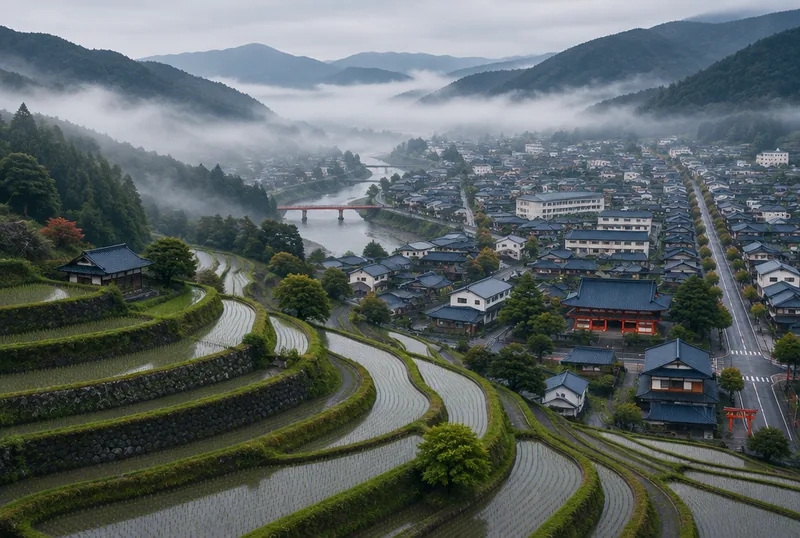
About three quarters of the land is mountainous, which is why cities crowd onto narrow coastal plains. Mount Fuji, at 3,776 m (12,388 ft), is the highest peak and an active volcano; it last erupted in 1707. The Shinano, at 367 km, is the longest river, and Lake Biwa in Shiga Prefecture is the largest lake. Japan sits where four tectonic plates meet and has about 110 active volcanoes, so earthquake drills, building codes and tsunami warnings are part of everyday life.
Seasons
The climate ranges from subarctic Hokkaido, with heavy winter snow, to subtropical Okinawa. Most of the country has four clear seasons. The rainy season, tsuyu, usually runs from June into July on Honshu, and typhoons are most frequent from August to October. Spring cherry blossoms and autumn leaves are the peak travel periods.
Government and the Imperial Family
Japan’s postwar Constitution took effect in 1947. It defines the emperor as the “symbol of the State and of the unity of the people” with no political powers; his duties are ceremonial, such as appointing the prime minister chosen by the Diet and receiving foreign ambassadors’ credentials. Emperor Naruhito acceded on 1 May 2019 after his father Akihito abdicated, which began the Reiwa era used in Japanese dates. His wife is Empress Masako.
Political power lies with the National Diet and the cabinet. The House of Representatives, the more powerful chamber, has 465 members; the House of Councillors has 248. The prime minister is elected by the Diet, usually the leader of the largest party. Sanae Takaichi of the Liberal Democratic Party became the first woman in the office in October 2025. Japan maintains more than 150 embassies abroad, plus consulates-general and permanent missions to international organizations.
Population
Japan’s population peaked around 2008 and has fallen every year since 2011. Fewer than 700,000 babies are now born each year, and nearly 30 percent of residents are 65 or older, one of the highest shares in the world. Life expectancy is about 81 years for men and 87 for women. The number of foreign residents has grown to roughly 3.8 million, many of them workers and students from Vietnam, China, the Philippines and Nepal, as Japan relies more on labor from abroad.
Economy and Currency
The Economy
Japan ranks among the five largest economies by nominal GDP. Its strengths are cars (Toyota is the world’s largest automaker by volume, alongside Honda, Nissan and others), industrial machinery, robotics, electronic components and the materials and equipment used to make semiconductors. Decades of trade surpluses and overseas investment have made Japan the world’s largest net creditor nation for most of the past three decades. Its Government Pension Investment Fund is the world’s largest pension fund, with about 294 trillion yen at the end of March 2026.
Money and Payments
The currency is the yen. New banknotes entered circulation on 3 July 2024: the 10,000-yen note shows industrialist Shibusawa Eiichi, the 5,000-yen note educator Tsuda Umeko and the 1,000-yen note bacteriologist Kitasato Shibasaburo. Older notes remain legal tender. Cash is still common in small restaurants and rural areas, but credit cards and rechargeable IC cards such as Suica and PASMO work on trains, in convenience stores and at most city shops.
Language and Writing
Japanese is spoken by virtually the entire population and is written with three scripts used together. Kanji are characters adopted from Chinese; the government’s list of joyo kanji for general use contains 2,136 characters. Hiragana (46 basic characters) writes grammatical endings and native words, and katakana (46 basic characters) writes foreign loanwords and names. Latin letters, called romaji, appear on signs and in stations. A 2019 law recognized the Ainu of Hokkaido as an indigenous people, and the Ryukyuan languages of Okinawa are classified as endangered.
National Symbols
- Flag: the Hinomaru, a red disc on a white field.
- Anthem: Kimigayo, one of the shortest national anthems in the world. Flag and anthem were given legal status by the Act on National Flag and Anthem of 1999.
- Emblems: the 16-petal chrysanthemum is the imperial seal; a stylized chrysanthemum also appears on the cover of Japanese passports, while the paulownia crest is the emblem of the prime minister and the government.
- Flowers: there is no legally designated national flower; the cherry blossom and the chrysanthemum both serve that role informally.
Education and Sport
Schooling is compulsory for nine years: six years of elementary school and three of junior high school. Almost every student goes on to three years of senior high school, and more than half continue to university or junior college. The school year starts in April.
Sumo is the traditional national sport, with six grand tournaments a year, three of them in Tokyo’s Ryogoku Kokugikan. Baseball draws the biggest crowds: Nippon Professional Baseball has 12 teams in two leagues. Soccer’s professional J.League has grown steadily since its launch in 1993.
Practical Facts for Visitors
- Entry: US citizens do not need a visa for tourist or business stays of up to 90 days.
- Electricity: 100 volts, with 50 Hz in eastern Japan including Tokyo and 60 Hz in the west including Osaka. Outlets take two-pin Type A plugs, so most US chargers fit without an adapter.
- Emergency numbers: 110 for police, 119 for fire and ambulance.
- Measurements: metric system; temperatures in Celsius.
- Tax-free shopping: from 1 November 2026, visitors pay the full price including consumption tax in the shop and receive the tax back after customs confirms the goods at departure.
Japan and Whaling
Whaling remains one of the most debated topics in Japan’s foreign relations. Japan withdrew from the International Whaling Commission in June 2019 and resumed commercial whaling on 1 July 2019. The hunt is limited to Japan’s territorial waters and exclusive economic zone, ending the long-running research whaling in the Antarctic. Annual catch limits are set by the Fisheries Agency and cover minke, Bryde’s and sei whales, and since 2024 fin whales. Whale meat is now a niche product; consumption is a small fraction of its postwar peak.
Frequently Asked Questions
Who is the head of state of Japan?
Emperor Naruhito, who acceded in May 2019. His role is ceremonial; the government is led by the prime minister, currently Sanae Takaichi.
What is the capital and largest city?
Tokyo is both. The city proper has about 14 million residents, and Greater Tokyo, including Yokohama, Kawasaki and Saitama, has about 37 million.
Do US citizens need a visa for Japan?
Not for tourism or business trips of up to 90 days. Work, study and longer stays require a visa issued by a Japanese embassy or consulate before travel.
What currency and plugs does Japan use?
The yen, and two-pin Type A plugs at 100 volts, the same shape as in the United States.