Japan has 14,125 islands within its territory, according to a 2023 survey by the Geospatial Information Authority of Japan. That answer is more than twice the figure many people still remember: 6,852. The jump does not mean thousands of new islands appeared. The islands were always there; the new survey simply counted them more precisely.
Why Japan now counts 14,125 islands
The total of 14,125 came from a digital recount completed by the Geospatial Information Authority of Japan, or GSI. Announced in February 2023 and finalized publicly the following month, it was the first official recount in 35 years. The earlier official number, 6,852, came from a 1987 Japan Coast Guard survey.
For the recount, GSI used 1:25,000-scale digital maps created with aerial photographs and satellite data. The survey treated a feature as an island when it was a natural land formation with a circumference of at least 100 meters. That rule follows the definition used in the United Nations Convention on the Law of the Sea.
The older survey depended on hand-drawn paper maps and manual counting. In dense island clusters, that approach could miss small natural islands. Digital mapping made those features easier to identify across Japan’s entire coastline, adding 7,273 islands to the official total.
What the new count changes and what it does not
The new number changes the inventory, not Japan’s physical size. Japan’s land area and territorial waters did not expand when the count rose from 6,852 to 14,125. None of the additional islands was newly formed; they had existed before the 2023 survey.
The count also excludes artificial islands and reclaimed land. Kansai International Airport, which was built on a reclaimed island in Osaka Bay, is therefore not part of the 14,125. The result is a count of natural land formations rather than every human-made feature surrounded by water.
| Official count | Islands | How it was produced |
|---|---|---|
| 1987 Japan Coast Guard survey | 6,852 | Paper maps and manual counting |
| 2023 GSI survey | 14,125 | Digital 1:25,000 maps, aerial photos, and satellite data |
| Difference | 7,273 | Previously missed natural islands, especially in clusters |
Japan is a long archipelago surrounded by sea
Japan is the world’s third-largest island country by land area, after Indonesia and Madagascar. Its total area is approximately 378,000 square kilometers, including 364,546 square kilometers of land and 13,430 square kilometers of inland water. A five-figure island count makes more sense once you see Japan as a long archipelago rather than just four large landmasses.
The country extends about 2,788 kilometers from Bentenjima in the north to Okinotorishima in the south. From Minami-Torishima in the east to Yonaguni in the west, it spans 3,146 kilometers. Japan has no land borders, and no point in the country is more than 150 kilometers from the sea.
Its coastline measures 29,751 kilometers, or more than 34,000 kilometers when the coasts of smaller islands are included. Japan’s Exclusive Economic Zone covers more than 4.47 million square kilometers, about 12 times its land area. It extends 200 nautical miles, or 370 kilometers, from the coastal baseline.
The four main islands hold about 97% of the land
Honshu, Hokkaido, Kyushu, and Shikoku are Japan’s four main islands. Together they account for about 97% of the country’s total land area. They are the standard answer when people ask which islands are the “main” ones, even though Japan also has large island groups farther south and east.
| Main island | Area | Approximate population | Useful distinction |
|---|---|---|---|
| Honshu | 227,960 km² | 104 million | Largest island in Japan |
| Hokkaido | 83,424 km² | 5.2 million | Second-largest island |
| Kyushu | 36,782 km² | 14.3 million | Third-largest island |
| Shikoku | 18,800 km² | 3.8 million | Smallest of the four |
Honshu, Shikoku, and Kyushu form a natural unit, separated only by narrow straits and the Seto Inland Sea. Hokkaido was fully annexed by Japan in 1869, after being known as the frontier territory of Ezo. These four islands provide the familiar map outline, but they represent only a small share of Japan’s 14,125 individual islands.
Honshu is Japan’s largest island by a wide margin
Honshu is Japan’s largest island at 227,960 square kilometers, and it is the seventh-largest island in the world by area. About 104 million people live there, making it the world’s second-most populous island after Java in Indonesia.
The island is roughly 1,300 kilometers long. Its width ranges from about 50 to 230 kilometers.
Okinawa is important, but it is not one of the standard four
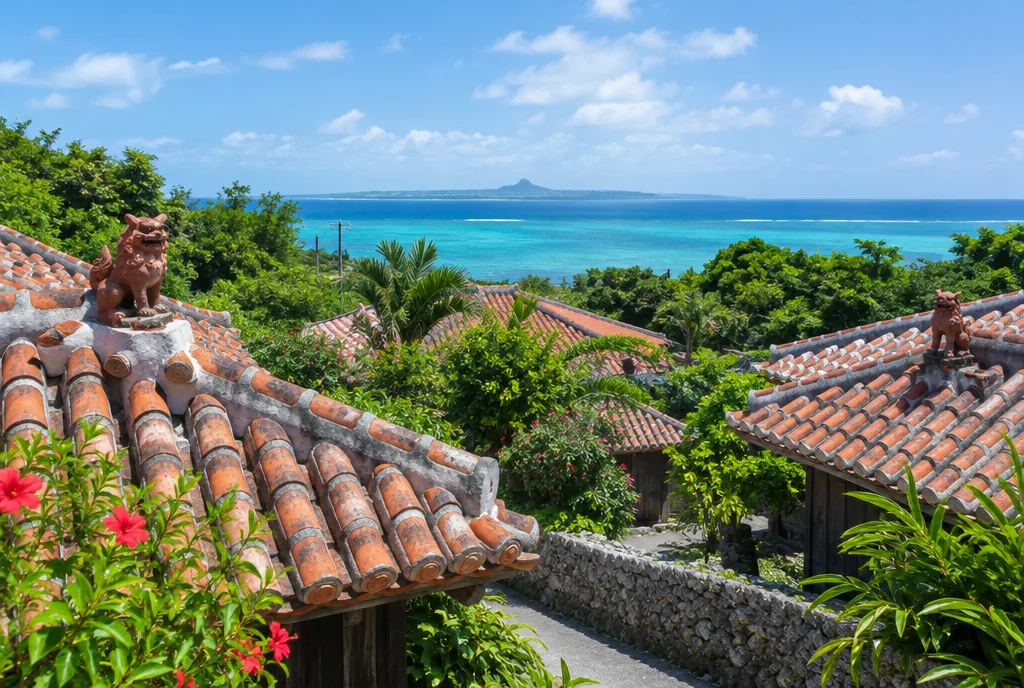
Okinawa Island, also called Okinawa-honto, is the largest island in the Ryukyu or Nansei archipelago. At 1,199 square kilometers, it is far smaller than Shikoku but is sometimes described as a “fifth main island.” In standard geographic usage, the four main islands remain Honshu, Hokkaido, Kyushu, and Shikoku.
Okinawa Prefecture consists of about 160 islands, roughly 49 of them inhabited. Its population is about 1.3 million, and it is Japan’s only subtropical region. The wider Nansei/Ryukyu chain stretches southwest from Kyushu, so the four-island shorthand leaves out a large part of the archipelago.
Most of Japan’s islands are uninhabited
Approximately 260 of Japan’s 14,125 islands are inhabited. Another estimate identifies around 421 inhabited remote islands under Japan’s Remote Islands Development Law. The two figures come from different sources and definitions, which is why they differ.
Either way, well over 13,800 islands are uninhabited, many of them tiny islets and rocks. Tokyo Prefecture alone governs 219 islands, yet only 11 are inhabited. Many inhabited remote islands are shrinking: numerous communities have lost more than half their population since the 1960s.
Four common misunderstandings about the island count
- “Japan discovered 7,273 new islands.” The additional islands were not new. The 2023 digital survey identified natural features that had been missed in the 1987 paper-map count.
- “Japan suddenly became larger.” The recount did not alter Japan’s land area or territorial waters; it changed the precision of the official inventory.
- “Every island-shaped feature is included.” Natural formations need a circumference of at least 100 meters, while artificial islands and reclaimed land are excluded.
- “Okinawa replaces one of the four main islands.” Okinawa is sometimes called a fifth main island, but the standard four are Honshu, Hokkaido, Kyushu, and Shikoku.
Frequently Asked Questions
How many islands does Japan have?
Japan has 14,125 islands within its territory under the 2023 GSI count. The survey counted natural land formations with a circumference of at least 100 meters.
What are the four main islands of Japan?
The four main islands are Honshu, Hokkaido, Kyushu, and Shikoku. Together, they make up about 97% of Japan’s total land area.
Why did Japan’s island count double to 14,125?
GSI used digital 1:25,000-scale maps, aerial photographs, and satellite data in 2023. The earlier 1987 survey used paper maps and manual counting, which missed many small islands in clusters.
How many Japanese islands are inhabited?
Approximately 260 islands are inhabited. A separate estimate counts around 421 inhabited remote islands under the Remote Islands Development Law.
What is the largest island in Japan?
Honshu is Japan’s largest island, covering 227,960 square kilometers. It is also the seventh-largest island in the world by area.