Japanese castles are far more than striking towers on stone walls: they are carefully staged systems of defense, government, trade, and status. Their wooden keeps, steep roofs, maze-like approaches, and castle towns tell a history that differs sharply from the familiar European model. Once you know what to look for, a Japanese castle becomes readable, from the first turn in the road to the highest floor of its keep.
Why Japanese castles look and work so differently
In Japanese, a castle is a shiro; when the word follows a place name, it is written -jō. On signs and maps, both use the character 城. Above the enclosures rises the main tower, the tenshu, also called tenshukaku, a name that literally means “heavenly protection.” The craft of building castles is chikujō-jutsu.
During the Sengoku period, from 1467 to 1603, builders created most castles that now define the classic image. In that era of warfare, the arrival of Portuguese firearms in 1543 encouraged new defensive building. The history produces a revealing contrast: in Europe, cannon helped make castles obsolete; in Japan, firearms helped fuel an intense period of castle construction.
The most visible difference is the material. Instead of using solid stone from foundation to roof, Japanese castles place timber buildings on stone bases. In earthquakes, wood is better able to withstand movement. For ishigaki walls, builders commonly used the mortarless nozurazumi method, so stones can shift rather than crack as one rigid mass.
Builders also did not usually put a continuous wall around an entire city. The stone walls marked the castle precinct, not the whole settlement beyond it. Within that precinct, defenses formed rings: the honmaru was the innermost bailey, then the ninomaru, then the sannomaru. An intruder who crossed one boundary still did not reach the ruler. Each ring added another controlled space.
How to read a Japanese castle as you approach it
Start with the terrain. A yamajiro is a mountain castle, a hirayamajiro sits on a hill, and a hirajiro is a flatland castle. The category tells you how builders used height, distance, and approach routes.
Then look past the main keep. The tenshu was not the whole defense. Along the route, gates, walls, moats, courtyards, and turns made attackers slow down and reveal themselves. In the walls, sama served as firing openings: yasama for arrows, teppōsama for guns, and taihōsama for cannon.
Imagine approaching through the outer enclosure. Because a straight run toward the tower would be easy to defend against, the route instead passes through successive rings, gates, and angled spaces. This sequence creates the effect: the keep remains visible, but reaching it becomes difficult. Beyond its military role, the tower was a focal point of power.
Why lords built castles and towns grew around them
Japanese castles had three jobs at once. They served as fortresses, residences for daimyō, and symbols of authority. Many stood on trade routes, where controlling people and goods could matter as much as holding a hill.
- Defense: a protected center with layered enclosures and satellite sites.
- Government: a daimyo residence and the base from which a territory was managed.
- Display: a prominent statement of political and economic power.
A powerful clan could maintain a honjō, or main castle, supported by shijō, satellite castles. This network extended influence rather than concentrating every function in one tower.
A jōkamachi grew around the castle, literally a “town below the castle.” About 300 planned castle towns existed. Kanazawa and Sendai had about 120,000 residents, while a smaller place such as Kameda had about 4,000. To make movement harder for an attacker, streets were angled and sometimes ended in cul-de-sacs. Separate districts held samurai, merchants, and temples.
Oda Nobunaga required samurai to live in the castle town through heinōbunri and encouraged free markets through rakuichi-rakuza. The effect was urban as well as military. More than half of Japanese cities with more than 100,000 people began as jōkamachi, so the legacy of castles reaches far beyond surviving walls and towers.
The 12 original Japanese castle keeps are the rare exception
More than 25,000 castles were built in Japanese history, but only 12 retain an original main keep. These are the genzon tenshu, original keeps built before 1868. Their rarity is one reason that a castle’s age and construction status matter as much as its silhouette.
| Original keep | National Treasure status | Notable fact |
|---|---|---|
| Hirosaki | No | One of the 12 genzon tenshu |
| Matsumoto | Yes | Oldest surviving five-exterior, six-interior-story keep |
| Maruoka | No | One of the 12 genzon tenshu |
| Inuyama | Yes | Traditionally dated to 1537, often called the oldest tenshu |
| Hikone | Yes | One of five National Treasure castles |
| Himeji | Yes | Highest original surviving tenshu |
| Matsue | Yes | One of five National Treasure castles |
| Bitchū Matsuyama | No | One of the 12 genzon tenshu |
| Kōchi | No | One of the 12 genzon tenshu |
| Marugame | No | One of the 12 genzon tenshu |
| Uwajima | No | One of the 12 genzon tenshu |
| Matsuyama (Ehime) | No | One of the 12 genzon tenshu |
The five National Treasure castles are Himeji, Matsumoto, Hikone, Inuyama, and Matsue. Inuyama’s tenshu is traditionally dated to 1537 and is often called the oldest surviving keep. These original keeps share a practical warning: their stairs are steeper than 60 degrees, and none has an elevator.
Ten famous Japanese castles give a useful starting list
A popularity survey listed the following famous Japanese castles. It is a guide to well-known names rather than a claim that one is objectively better than another.
- Himeji
- Matsumoto
- Goryokaku
- Osaka
- Nagoya
- Kumamoto
- Nijō
- Hirosaki
- Hikone
- Inuyama
The list spans sharply different survival stories. Kumamoto is often grouped with Himeji and Matsumoto among Japan’s most important castles, yet its tenshu was destroyed in 1877 and rebuilt in concrete in 1960. That comparison is a useful reminder: fame, age, and originality are separate questions.
Himeji, Matsumoto, and Osaka reveal three castle stories
Himeji Castle: the White Egret
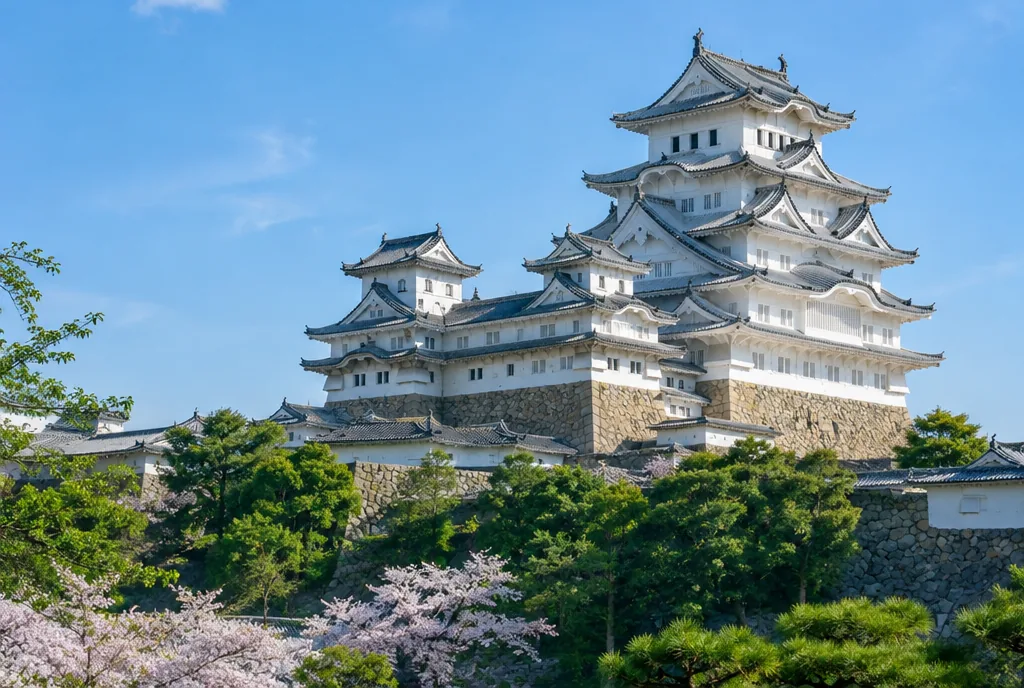
Himeji Castle in Hyōgo Prefecture covers 107 hectares and contains 83 buildings. Its white plaster walls and graceful roof lines gave it the name Shirasagi-jō, or White Egret Castle. The current form was completed around 1618 after Toyotomi Hideyoshi began expansion in 1580 and Honda Tadamasa completed it.
It became Japan’s first UNESCO World Heritage site in 1993. Its main tower is five stories on the outside and six levels within, reaching 46.5 meters in total. It is the highest surviving original tenshu. Most remarkably, Himeji is the only Japanese castle never destroyed by war, earthquake, or fire; it survived the 1995 Hanshin earthquake as well as World War II.
Matsumoto Castle: the Black Crow
Matsumoto Castle in Nagano Prefecture was built in 1594. Its black wooden cladding earned it the name Karasu-jō, or Crow Castle, making a visual opposite to white Himeji. It is a flatland castle with a moat; its tower is 30 meters tall on a seven-meter stone base.
It is also the oldest surviving five-exterior, six-interior-story tenshu. Few windows and many firing openings reflect Sengoku-era military needs. Public protest during the Meiji era saved Matsumoto from demolition, a civic intervention that explains why it is still an original keep rather than a reconstruction.
Osaka Castle: power and reconstruction
Toyotomi Hideyoshi built Osaka Castle in 1583. Today’s tower is a historically inaccurate concrete reconstruction from 1931, with five exterior floors and eight interior floors. The grounds cover 61,000 square meters, and 13 site buildings, among them gates and watchtowers, are designated Important Cultural Property.
Osaka’s walls also show the scale of its construction. They use rough, mortarless “burdock piling,” and the Octopus Stone weighs more than 100 tons. It is an essential castle site, but its main tower should not be mistaken for an original tenshu.
Demolition and war explain why so little remains
During the Edo period, about 170 castles operated at the same time. In 1615, the Tokugawa shogunate issued the one-castle-per-province order. Later, on January 14, 1873, the Meiji government’s Haijō Edict opened castles to demolition or civilian use. A 12-person team had already visited about 200 castles in 1872 to judge their military value.
World War II brought another wave of loss. Air raids destroyed castles including Nagoya and Okayama, while Hiroshima Castle was destroyed by the atomic bomb on August 6, 1945. Edo Castle’s 58.8-meter tenshu had burned in 1657 and was never rebuilt; the Tokugawa Osaka tenshu, 57.3 meters high, burned after a lightning strike in 1665.
About 200 castle sites remain today. Most visible castles are concrete reconstructions from the 1950s and 1960s. That does not make them uninteresting; it does mean the material and survival story should be part of how they are understood.
Common misconceptions hide the most interesting details
“Every Japanese castle is an original building.”
No. A castle site may preserve walls, moats, gates, or watchtowers while its tenshu is reconstructed. Only 12 castles have an original keep. Osaka’s 1931 concrete tower and Kumamoto’s 1960 concrete rebuilding illustrate the difference.
“Japanese castles are all stone.”
The walls and bases are stone, but the towers are fundamentally timber structures on stone foundations. This choice relates directly to earthquake resilience.
“A castle was just a samurai home.”
A daimyo did reside there, but a castle was also a fortress, an administrative center, and a power symbol connected to trade routes and a planned town.
Frequently Asked Questions
What are Japanese castles called?
They are called shiro, or -jō when the term follows a place name. The main keep is the tenshu or tenshukaku.
Why are Japanese castles so different?
They combine timber buildings with mortarless stone bases, concentric defensive rings, and routes shaped by gates and terrain. Unlike many European fortresses, they generally did not encircle the whole city with one continuous wall.
What are the 12 original Japanese castles?
The genzon tenshu are Hirosaki, Matsumoto, Maruoka, Inuyama, Hikone, Himeji, Matsue, Bitchū Matsuyama, Kōchi, Marugame, Uwajima, and Matsuyama in Ehime.
What are the top 10 castles in Japan?
A popularity survey lists Himeji, Matsumoto, Goryokaku, Osaka, Nagoya, Kumamoto, Nijō, Hirosaki, Hikone, and Inuyama. It is a popularity list, not a measure of originality or historical importance.
How many Japanese castles are still standing?
About 200 castle sites remain, but only 12 main keeps are original. More than 25,000 castles were built over Japanese history, and most visible keeps today are postwar-era concrete reconstructions.